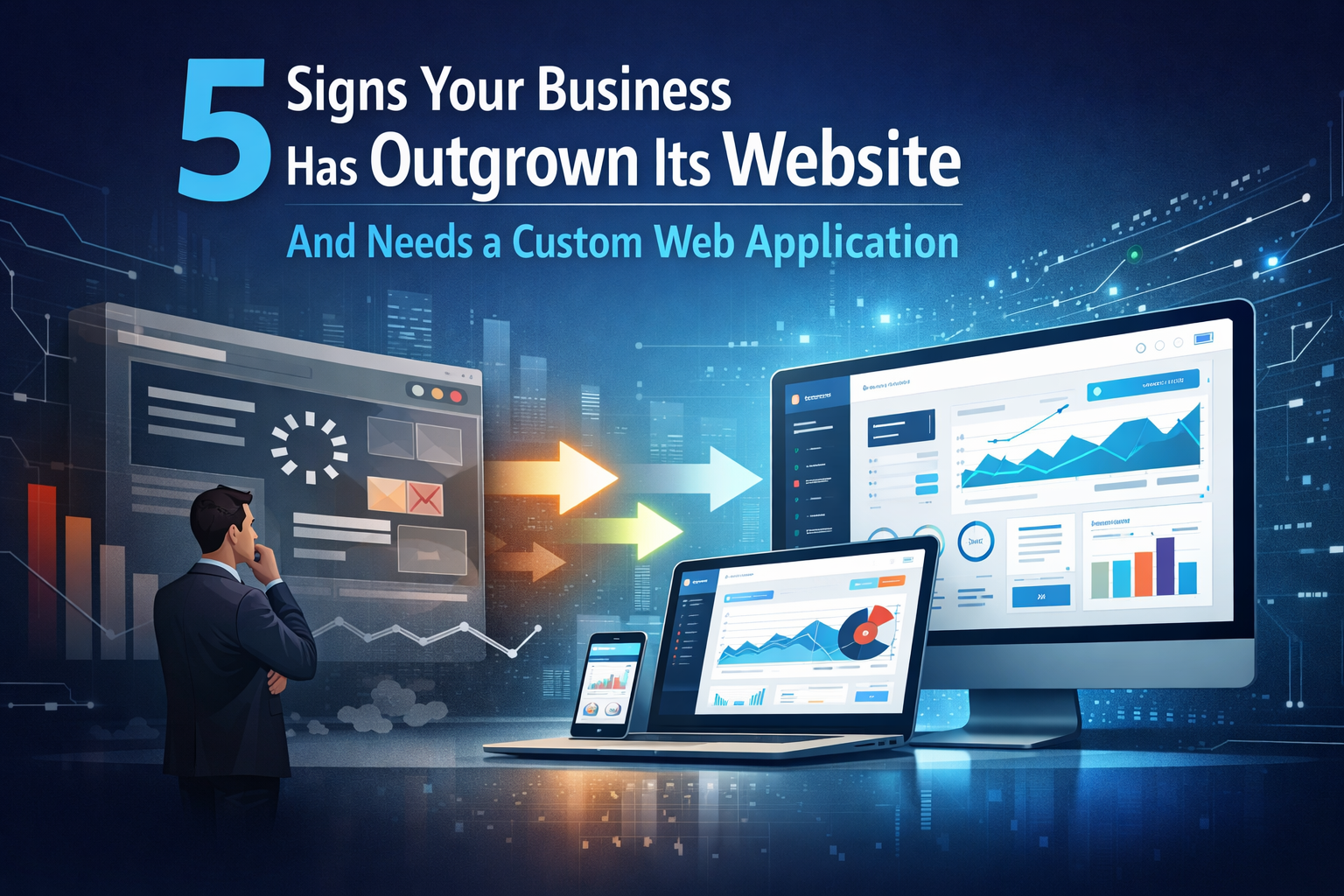
As businesses grow and evolve, their digital needs become increasingly complex. What started as a simple website showcasing your products or services may no longer be sufficient to support your operations and customer expectations. Many successful Philippine businesses reach a critical point where their website becomes a limitation rather than an asset. Understanding when it’s time to transition from a traditional website to a custom web application can be the difference between scaling smoothly and struggling with inefficient processes.
Sign 1: You’re Spending Hours on Manual, Repetitive Tasks
One of the clearest indicators that you need more than a basic website is when your team spends significant time on repetitive manual tasks that should be automated. Are you manually processing orders, updating inventory across multiple platforms, or copying data from one system to another? These are tasks that a custom web application can automate seamlessly.
For example, if you’re running an e-commerce business and find yourself manually updating stock levels, sending order confirmations, or generating reports by hand, you’re losing valuable time that could be spent on strategic growth activities. A custom web application can integrate these processes, creating workflows that handle routine tasks automatically while giving you real-time insights into your operations.
Sign 2: Your Customers Need Personalized Dashboards or User Accounts
Standard websites are excellent for displaying information and accepting basic form submissions, but they struggle when customers need personalized, interactive experiences. If your clients are requesting features like custom dashboards, project tracking portals, account management systems, or personalized reporting tools, your traditional website architecture simply won’t cut it.
Businesses offering services such as consulting, project management, educational courses, or subscription-based products often reach this threshold quickly. When customers need to log in, view their specific data, track progress, or interact with your business in a personalized way, you’ve entered web application territory. This level of functionality requires a more sophisticated architecture than standard website development services typically provide.
Sign 3: You’re Juggling Multiple Disconnected Tools and Platforms
Are you using one platform for customer relationship management, another for inventory, a third for invoicing, and yet another for project management? When your business operations are scattered across multiple disconnected tools, you’re creating inefficiencies, increasing the risk of errors, and making it harder to get a comprehensive view of your business.
A custom web application can serve as a centralized hub that brings all these functions together. Instead of logging into five different platforms and manually synchronizing data between them, you can have a single, integrated system tailored specifically to your workflow. This is particularly valuable for Philippine businesses looking to compete more effectively by streamlining operations and reducing overhead costs associated with multiple software subscriptions.
Sign 4: Your Data Management Has Become Unmanageable
As your business grows, so does the volume and complexity of your data. If you’re struggling to manage customer information, track transactions, generate meaningful reports, or maintain data integrity across your organization, these are strong signals that you need more robust database management than a traditional website offers.
Web applications are built with sophisticated database architectures that can handle complex relationships between different types of data, process large volumes of information efficiently, and provide powerful querying and reporting capabilities. Whether you’re dealing with customer data, inventory information, financial records, or operational metrics, a custom solution ensures your data works for you rather than against you.
Sign 5: You’re Limiting Customer Experiences Due to Technical Constraints
Perhaps the most business-critical sign is when you find yourself saying \”no\” to customer requests or limiting your service offerings because your website can’t support what you want to do. Maybe you want to offer a customer portal where clients can submit requests and track progress, but your website platform doesn’t support it. Or perhaps you want to create a unique booking system with complex rules and integrations that your current setup can’t handle.
These limitations don’t just frustrate you—they directly impact your revenue and competitive position. In today’s digital marketplace, businesses that can’t deliver the experiences customers expect will lose ground to competitors who can. When technical limitations are holding back your business vision, it’s time to invest in custom application development that enables rather than restricts your growth.
Making the Transition: What Comes Next?
Recognizing these signs is the first step. The transition from a website to a web application is a significant move that requires careful planning and the right development partner. Unlike template-based websites, custom applications are built specifically around your business processes, user needs, and growth objectives.
The good news is that this transition doesn’t have to mean abandoning everything you’ve built. Many businesses successfully evolve their digital presence incrementally, starting with core application features while maintaining their existing website. Working with experienced developers who understand both website development and application architecture ensures a smooth transition that protects your investment while enabling new capabilities.
If you’re experiencing one or more of these signs, it’s worth having a conversation with a development professional about your options. The right custom web application can transform your operations, delight your customers, and position your Philippine business for sustained growth in an increasingly digital marketplace.